What Does Facebook Look Like?

By Dan Licht (@thedvl)

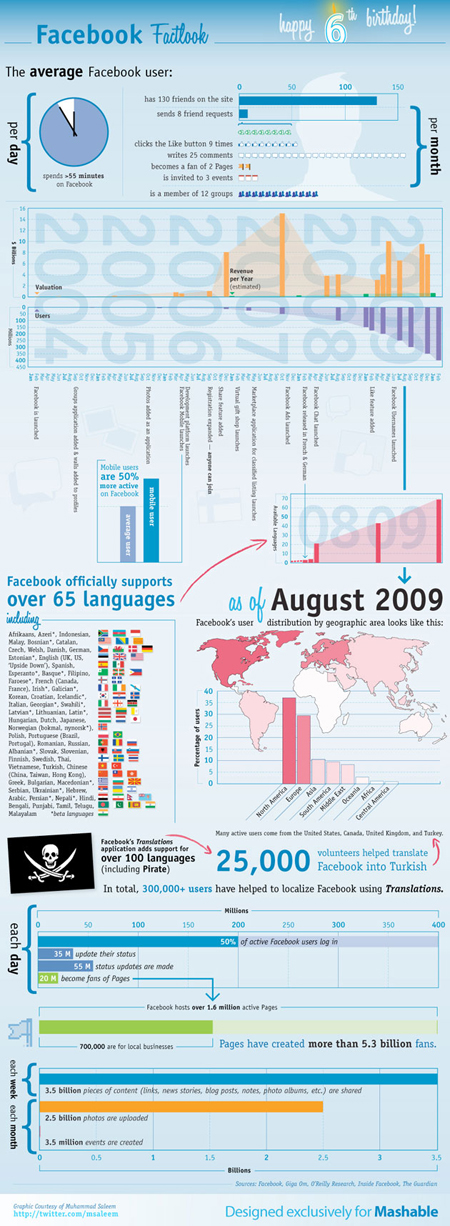
Can you ever get enough great infographics? We don’t think so. Continuing our data visualization themed week, here’s a great visualization of the 6 year history of Facebook from our friends at Mashable (designed by the incomparable Muhammad Saleem).

Don’t you wish they taught history this way when you were in grade school?


Where Do You Live in the United States of Facebook?

By Sven Larsen (@zemoga)

What can data analysis and visualization tell us about ourselves?

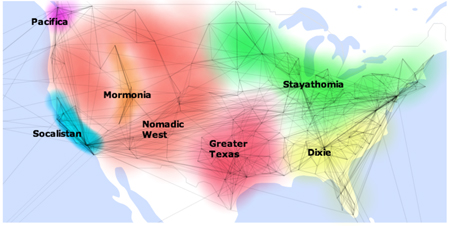
This fascinating graphic from Pete Warden shows how cities and topics are related on Facebook. It’s a thoroughly modern take on the classic NINE NATIONS OF NORTH AMERICA.

You can read Pete’s full analysis of the data here.  It’s a terrific look at how we behave online and also a terrific illustration of the wealth of information that’s available on the Internet.

How are you taking advantage of all the data that’s out there? And how are you using it to create compelling content?


What Does the Internet Look Like?

By Sven Larsen (@zemoga) We’ve mentioned before how much we love data visualization. And it seems like we’re not alone. The chart above was created by Focus Research and is meant to display the stte of the Internet in one easy to view graphic.

It’s an ambitious project and we think they’ve done a very good job with it. As generations grow up with a marriage of visuals and text and data becomes ever more complex (and available), being able to present information clearly will become an essential marketing skill.

Do you deal with large amounts of data in your business? How can you make it easier for your customers to understand the information you’re providing them?


Introducing the Health Tweeder!

We’ve written a lot about data aggregation and visualization here. Now our sister blog/service offering, Pixels & Pills has launched a new Twitter aggregator called The Health Tweeder. We think it’s a terrific example of how to filter data in a visually appealing manner that helps promote education and conversation. Here’s the official announcement from P & P co-founder Mike Myers.


Are We Living in a Reboot Culture?

By Sven Larsen (@zemoga)

Ever heard the phrase “creative destruction”?

It’s one of the more applicable oxymorons in digital culture.

There are many people who believe that the Internet fosters this particular type of behavior … that is, destroying old business models or ways of doing things and replacing them with more efficient (or at least different) ways of doing things. Apple‘s iTunes store is a perfect example of this, replacing the old model of going to a specific destination to buy environmentally unfriendly pieces of plastic with a digital alternative that can be purchased almost anywhere. A creative solution that ended up destroying the old business model of the music industry and (arguably) a change for the better.

The last ten years have seen a tremendous abundance of examples of this process. Craig’s List destroying traditional classified advertising. Mobile phones destroying the need for phone booths. Pornography websites replacing the need for creepy Times Square theaters. Well … you get the idea. Read more


What's Next After Google?

By Sven Larsen (@zemoga)

I’m catching up on some reading thanks to a few business trips. One of the volumes I was most looking forward to consuming is Ken Auletta’s GOOGLED, a comprehensive history of the search giant. While I’m just a couple of pages in to it so far, I can tell the book is going to provide some unique insights.

A passage from the book that really caught my attention was a quote from Google’s Chief Economist, Hal Varian. “The internet makes information available,” opined Varian, “Google makes it accessible.” It’s a concise summary of Google’s business but it also captures the essential struggle for all of us in the digital communications business – how to take raw data and turn it in to something compelling for consumers.

It’s my strong belief that as social media becomes more and more integrated in to our lives, accessibility will become more and more of an issue. Already, we’ve seen celebrities (both real and web versions) deleting Facebook pages and declaring Twitter blackout periods. In almost all these cases, it’s not the constant demand for content that these services require that is cited as the problem. It’s keeping up with the massive flow of information the other way. With literally millions of tweets and Facebook postings what are we supposed to pay attention to? Read more
 

What Embodies Innovation More …

… than Lego? The company that sparked a million kids’ imaginations has also been a leader in adapting technology like augmented reality and 3D animation. Their latest offering is Legoclick a new community devoted to innovation. Check out this awesome short film they created to give users a little taste of the site.


How to Jump Start 2010

By Sven Larsen (@zemoga)

How are you motivating yourself and your team in the coming year?

As we all workshift, freelance, consult, and work in new ways, this seems to be a bigger and bigger issue for managers and client-agency relationships.  That’s why I was excited to receive my copy of Daniel Pink’s new Book, DRIVE in my mail this